Who Is a Human in the Era of AI? Dr. Mokua Challenges Catholic TVET Leaders
The question of what it means to be human in an age of artificial intelligence took centre stage at the 2026 Catholic TVET Networks National Conference, as Dr. Mokua challenged Catholic TVET leaders to embrace AI without losing sight of human dignity.
The Executive Director of the Loyola Center for Media and Communications (LCMC) was speaking to 51 principals and directors at the conference organised by the Kenya Conference of Catholic Bishops (KCCB).
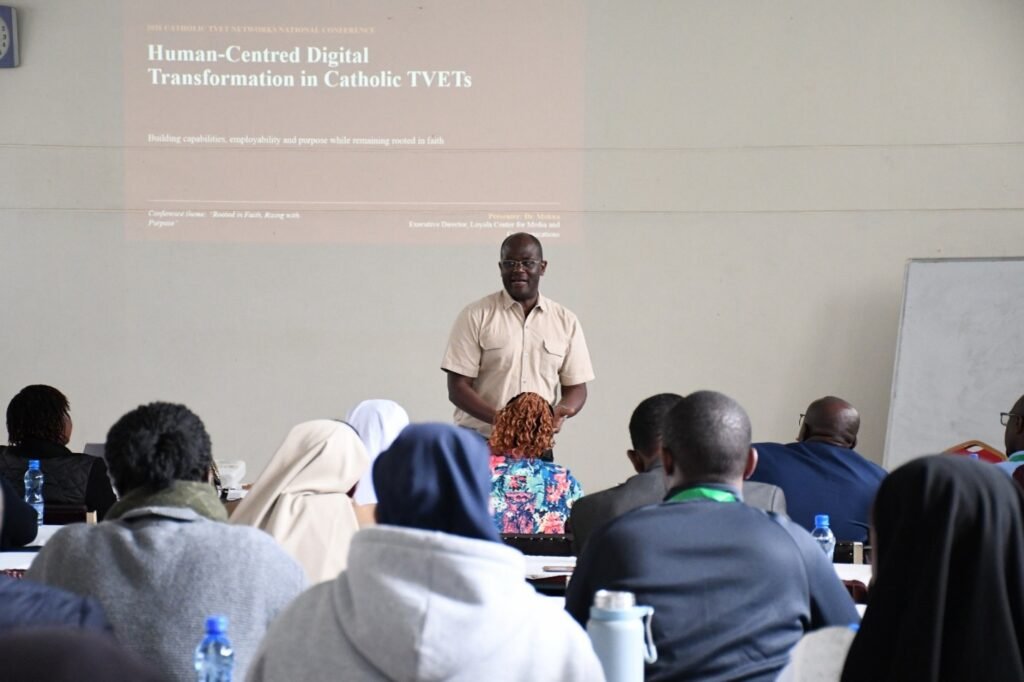 Dr. Elias Mokua, SJ, addresses Catholic TVET leaders on human-centred digital transformation during the TVET conference at JJ McCarthy Centre, Karen.
Under the theme “Rooted in Faith, Rising with Purpose,” Dr. Mokua said digital transformation in Catholic TVET institutions must remain centred on learners and the common good.
He cautioned leaders against allowing AI to replace human responsibility. AI can support human judgement, he said, but decisions must remain subject to human oversight.
He urged institutions to consider accuracy, fairness, transparency, accountability and human dignity whenever they use AI.
In his presentation, “Human-Centred Digital Transformation in Catholic TVETs,” Dr. Mokua also stressed the importance of human accompaniment.
Technology, he said, should enhance rather than replace the role of teachers and mentors. Learners are more than performance profiles or data points. They also need dialogue, encouragement, guidance, character formation and compassion.
Dr. Mokua demonstrated how AI is transforming education through technologies such as virtual reality, augmented reality and extended reality. At the same time, he urged leaders to keep the human person at the centre of this transformation.
He referred to Pope Leo XIV’s encyclical Magnifica Humanitas, which calls for human dignity to remain central to technological progress. Digital tools, he noted, should serve humanity rather than reduce people to data, commodities or performance measures.
He further urged TVET institutions to ensure that their data systems are secure and inclusive. Such systems should also remain subject to human review, particularly when used for assessment.
“Whatever we do with AI, we must remember to keep human dignity,” he said.
Catholic TVET institutions, he added, should use technology to become more effective while ensuring they never become less human.




Who Is a Human in the Era of AI? Dr. Mokua Challenges Catholic TVET Leaders
The question of what it means to be human in an age of artificial intelligence took centre stage at the 2026 Catholic TVET Networks National Conference, as Dr. Mokua challenged Catholic TVET leaders to embrace AI without losing sight of human dignity.
The Executive Director of the Loyola Center for Media and Communications (LCMC) was speaking to 51 principals and directors at the conference organised by the Kenya Conference of Catholic Bishops (KCCB).
Under the theme “Rooted in Faith, Rising with Purpose,” Dr. Mokua said digital transformation in Catholic TVET institutions must remain centred on learners and the common good.
He cautioned leaders against allowing AI to replace human responsibility. AI can support human judgement, he said, but decisions must remain subject to human oversight.
He urged institutions to consider accuracy, fairness, transparency, accountability and human dignity whenever they use AI.
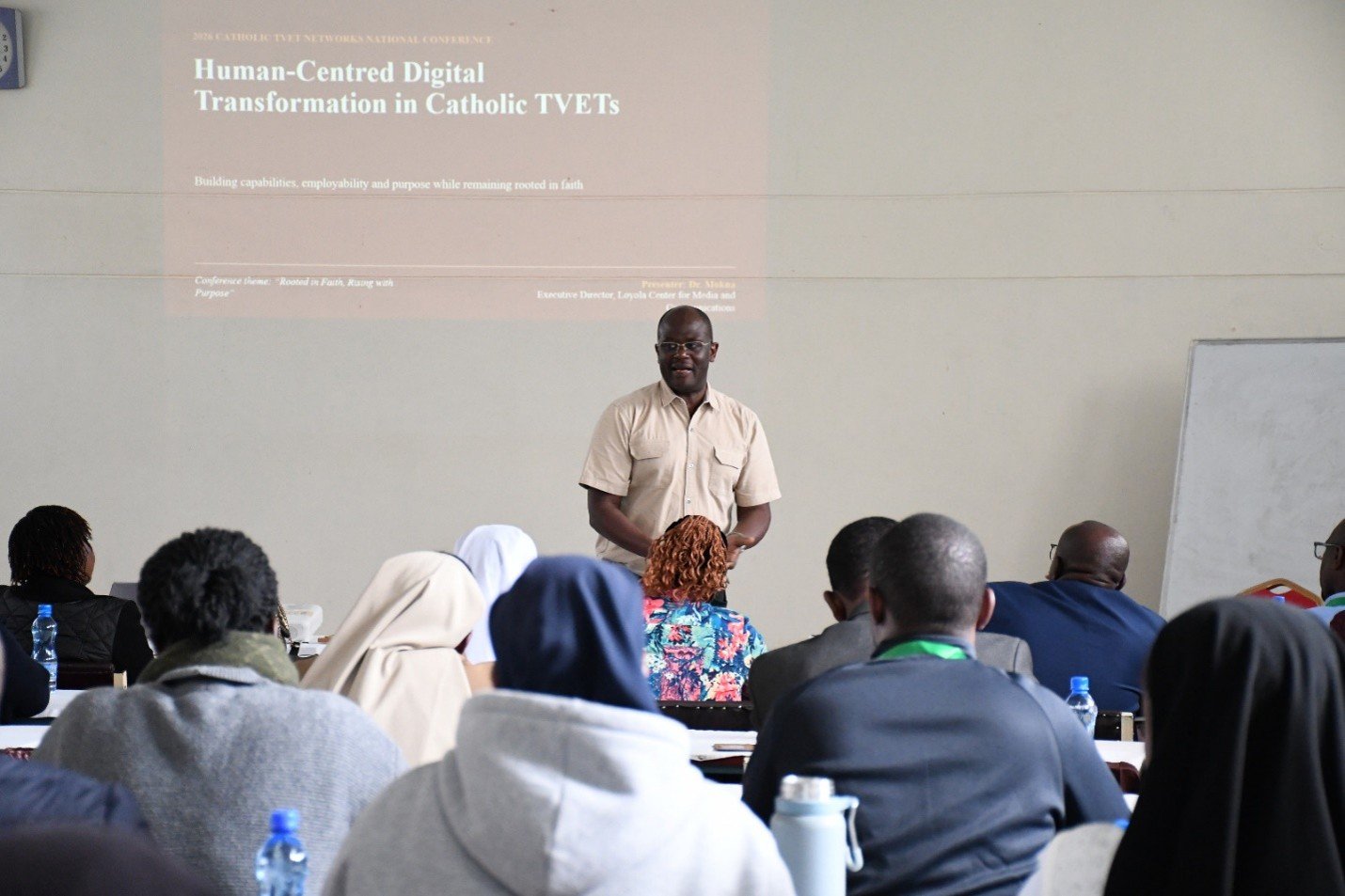
In his presentation, “Human-Centred Digital Transformation in Catholic TVETs,” Dr. Mokua also stressed the importance of human accompaniment.
Technology, he said, should enhance rather than replace the role of teachers and mentors. Learners are more than performance profiles or data points. They also need dialogue, encouragement, guidance, character formation and compassion.
Dr. Mokua demonstrated how AI is transforming education through technologies such as virtual reality, augmented reality and extended reality. At the same time, he urged leaders to keep the human person at the centre of this transformation.
He referred to Pope Leo XIV’s encyclical Magnifica Humanitas, which calls for human dignity to remain central to technological progress. Digital tools, he noted, should serve humanity rather than reduce people to data, commodities or performance measures.
He further urged TVET institutions to ensure that their data systems are secure and inclusive. Such systems should also remain subject to human review, particularly when used for assessment.
“Whatever we do with AI, we must remember to keep human dignity,” he said.
Catholic TVET institutions, he added, should use technology to become more effective while ensuring they never become less human.
Share This:
Related Posts
Who Is a Human in the Era of AI? Dr. Mokua Challenges…
UNICEF Estimates That 20 Million Children Experienced Online Sexual Exploitation or Abuse…
The Future Is Intelligent. Is Your Team Ready? Artificial intelligence is no…
Don’t make children feel like Failures The mission of Loyola Centre for…
Mombasa’s Young Adults Embrace Digital Careers with Skills in Performance Art and…
Catholic Child Care Leaders Showcase Photography Skills to Elevate Visual Storytelling In…
AI Training Ushers in a New Era for Parish Communication By Teresia…
From Resistance to Discernment: The Church and AI By Teresia Muia As…
Making of Teenage Servant Leaders By Teresia Muia “Effective communication and conflict…